
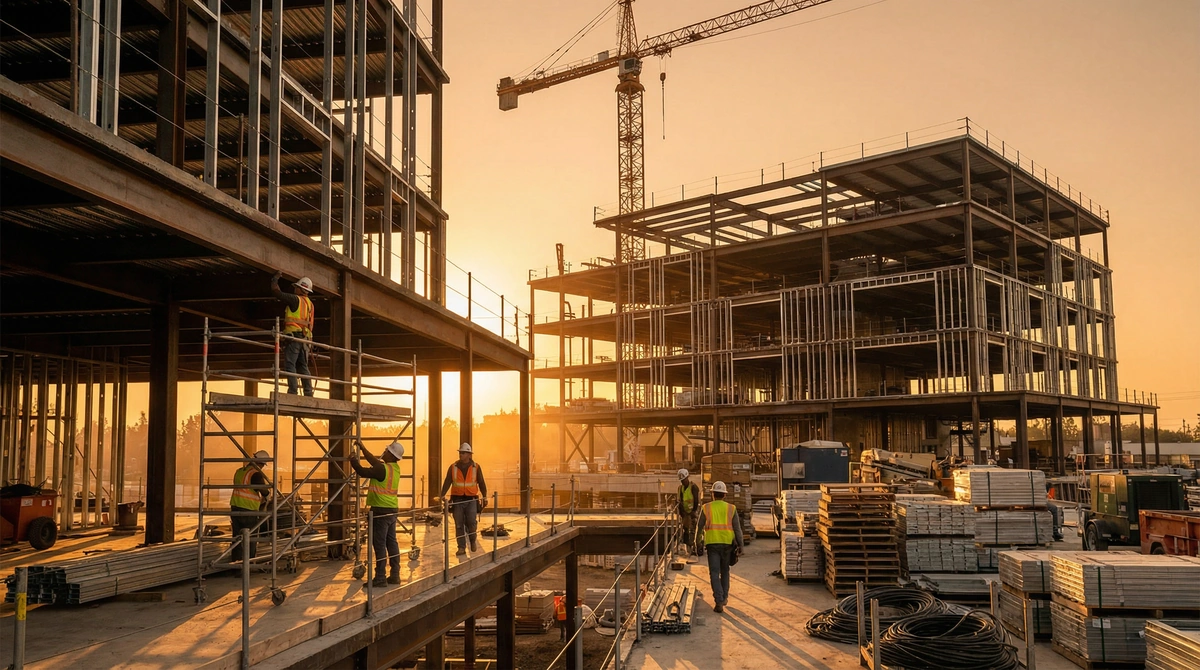
You just finished a $200,000 phase on a commercial build. The invoice is submitted. Now you wait — 60, 75, sometimes 90+ days for the general contractor to pay. Meanwhile, your crew needs paying next Friday, materials for the next phase are due in two weeks, and your line of credit is already stretched thin.
Construction invoice factoring exists to solve exactly this problem. It turns your completed-work invoices into cash within 24-48 hours, so you can keep projects moving without waiting months for payment.
Why Construction Cash Flow Is Uniquely Brutal
Construction operates on longer payment cycles than almost any other industry. General contractors and project owners routinely pay on net-60 to net-90 terms — and that’s before the inevitable delays from change orders, inspections, and disputes.
The average construction business waits 83 days to collect payment — longer than nearly any other industry. That’s three months of payroll, materials, and overhead you’re financing out of pocket.
Add retainage to the equation — the 5-10% withheld by the GC until the entire project is complete — and your cash flow gets even tighter. Subcontractors bear the worst of it: they’re typically the last to get paid in the construction payment chain, but the first to need cash for labor and materials.
How Construction Invoice Factoring Works
The process is straightforward once you understand the mechanics. Here’s how a typical construction factoring arrangement flows from invoice to cash. For a broader view of the process, see our complete step-by-step blueprint for AR financing.
Submit Your Completed-Work Invoice
After completing a project phase or delivering materials, submit the invoice to both the GC/project owner and the factoring company. Only invoices for completed, approved work are eligible.
Verification and Approval
The factoring company verifies the invoice is legitimate — they confirm the work was completed, the GC acknowledges the debt, and there are no disputes. This typically takes a few hours to one business day.
Receive Your Advance (80-90% of Invoice Value)
Within 24-48 hours, the factor wires 80-90% of the invoice face value directly to your account. On a $100,000 invoice at 85% advance, that’s $85,000 in your bank within two days.
Collection and Reserve Release
The factor collects the full payment from the GC when the invoice comes due. After deducting their fee (typically 1-4% per 30-day period), they release the remaining reserve to you.
What Qualifies (and What Doesn’t)
Not every construction receivable is factorable. Understanding the boundaries upfront saves time and frustration.
| Factorable | Not Factorable |
|---|---|
| Invoices for completed work | Retainage (5-10% holdback) |
| Delivered materials with proof of delivery | Incomplete or in-progress work |
| Approved change orders | Disputed invoices |
| Progress billings (if work is verified complete) | Deposits or prepayments |
| Government contract invoices | Invoices to non-creditworthy GCs |
Watch Out
Retainage is never factorable. If your contract includes a 10% retainage holdback, plan your cash flow to account for that locked-up capital until the project reaches final completion. Some projects hold retainage for months after substantial completion.
Construction-Specific Considerations
Construction factoring has nuances that don’t apply to other industries. Before you sign with a factor, make sure you understand these:
- Bonding capacity: Factoring is a sale of an asset, not a loan. It typically does not appear as debt on your balance sheet and should not reduce your bonding capacity.
- Mechanic’s lien rights: Make sure your factoring agreement preserves your right to file a mechanic’s lien. A good construction factor will structure the arrangement to keep your lien rights intact.
- Joint check arrangements: Some GCs require joint checks (made out to both you and your material suppliers). Your factoring company should be experienced in handling these.
- Notification: Most construction factoring is notification-based — the GC knows you’re factoring. In construction this is common and usually not a concern, since factoring is widely used in the industry.
Pro Tip
Since factoring is structured as a sale (not a loan), it typically does not count against your debt load when sureties evaluate your bonding capacity. This is one of the biggest advantages for construction companies that need to bond new projects while managing cash flow.

How to Choose a Construction Factoring Company
Not all factoring companies understand construction. Here’s what to look for:
- 1. Industry experience: They should understand progress billing, retainage, GC payment patterns, and construction contract structures. Ask how many construction clients they serve.
- 2. Transparent pricing: Confirm advance rates, factor fees, and any hidden charges (wire fees, credit check fees, early termination fees). See our guide on choosing an AR financing company without getting burned.
- 3. Project type coverage: Verify they work with your project types — commercial, residential, government, and infrastructure projects each have different payment dynamics.
- 4. Lien and bond awareness: A construction-savvy factor will proactively address mechanic’s lien preservation and bonding implications.
Is Construction Invoice Factoring Worth the Cost?
The math usually speaks for itself. Factoring a $100,000 invoice at 2.5% costs $2,500. If that $100,000 lets you fund a $400,000 project that you’d otherwise have to turn down, the return on that $2,500 investment is 16x.
Compare that to the alternatives: maxing out credit cards at 20%+ APR, missing payroll and losing your crew, or turning down profitable projects because you can’t float the upfront costs. As we covered in our look at the industries where AR financing changes everything, construction is one of the verticals where factoring delivers the most impact.
The real question isn’t whether you can afford to factor — it’s whether you can afford not to. For contractors and subcontractors dealing with 60-90 day payment cycles, construction invoice factoring is often the difference between growing your business and just surviving. You can also compare factoring to traditional lending at SBA’s business funding guide.
Stop Waiting 90 Days for Money You’ve Already Earned
Construction cash flow doesn’t have to hold your business back. Factoring lets you take on more projects, keep crews busy, pay vendors on time, and bid on bigger opportunities — all without taking on traditional debt or giving up equity.
Your completed work has value. There’s no reason to wait three months to access it.
Turn Your Construction Invoices Into Working Capital
You’ve done the work. You’ve earned the money. Stop waiting 90 days to access it. LineFlowAR helps construction companies get funded in 24-48 hours.